



The Wrong Horizon
A 6am walk on Anna Maria Island, a little card with a blue window, and a different way of looking at the lights behind a beach.
It's a little before six, and Cortez Beach is the colour of wet slate. I've come to meet Kristen Mazzarella, who runs Anna Maria Island Turtle Watch and Shorebird Monitoring - the charity that walks this shoreline every morning of the nesting season looking for tracks in the sand. I'd written to her weeks before, because I wanted to understand something I'd only read about: what a lighting monitoring walk actually involves, and what happens when the lighting is wrong.
Before we'd walked far, she handed me a card. Small, double sided, a turtle hatchling on the front, and a circle of dark blue film set into it. You hold it up to your eye and look through the window at the buildings behind the beach. Some lights disappear through the filter. Others glow through it, a hard, electric violet. It takes about a second to learn how to look.
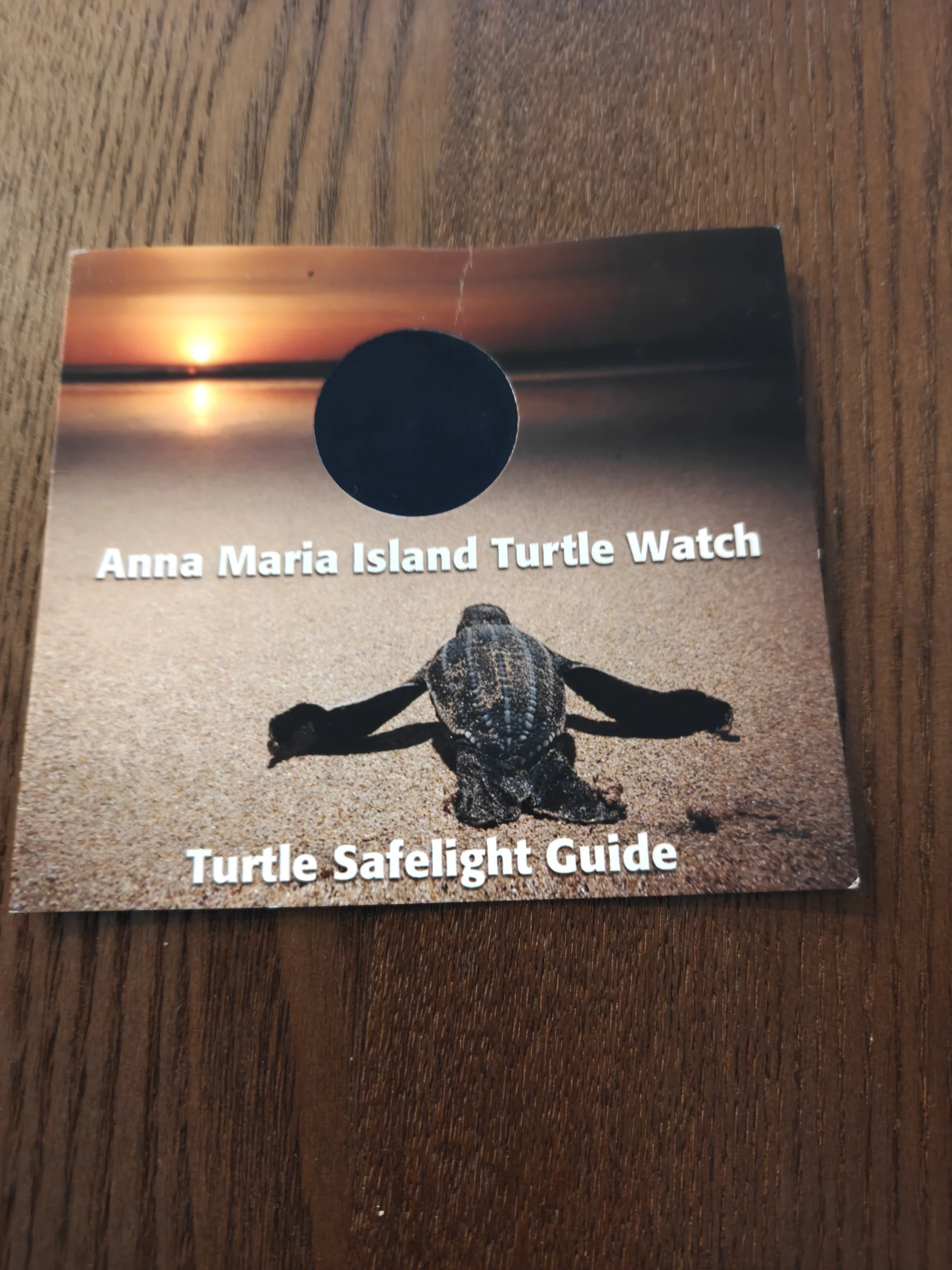
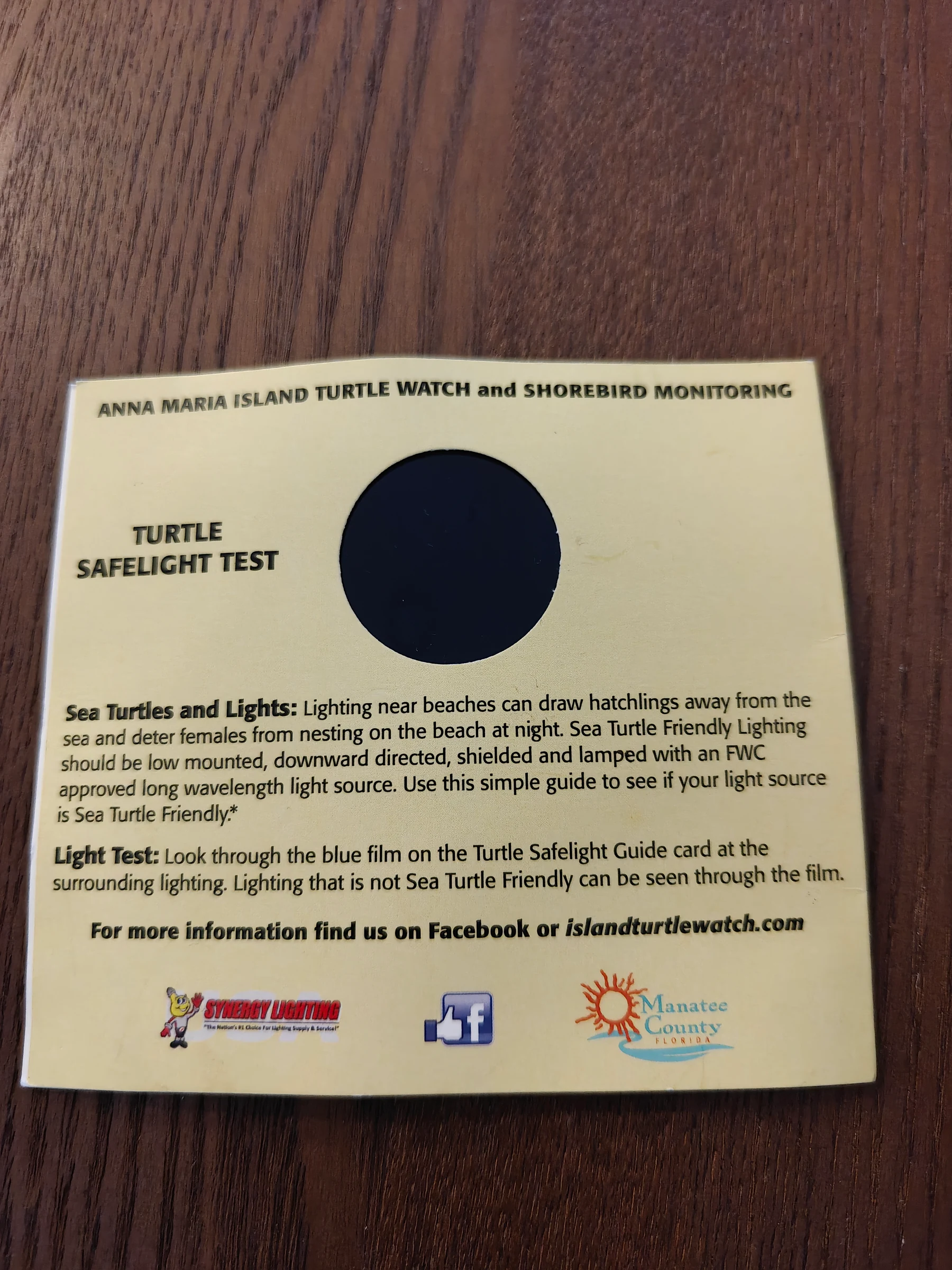
I looked through it at the row of homes and businesses along the road behind the beach. Some of them vanished into the dark. Some of them lit up like a warning.
Why a beach has to be dark
Sea turtle hatchlings emerging at night use the relative patterns of light and dark to find the water. The low, open horizon over the sea helps guide them away from the darker land. Artificial light behind the beach can disrupt those cues, drawing them inland towards buildings, parking lots and roads.
The numbers behind the walk
In its September 18, 2026 weekly update, Anna Maria Island Turtle Watch reported 256 disoriented hatchlings found dead so far that season. Of 242 nests that had hatched, 88 had hatchlings disorient at emergence: 36%. That is a measure of affected nests, not the percentage of all hatchlings.
During September 12-18 alone, nine of the 18 nests that hatched experienced disorientation, and 34 more hatchlings were found dead in the road. The breakdown by town makes difficult reading.
| Town | Affected nests / hatched nests | Rate | Hatchlings found dead |
|---|---|---|---|
| Anna Maria | 3 / 46 | 7% | 1 |
| Holmes Beach | 24 / 71 | 34% | 4 |
| Bradenton Beach | 61 / 125 | 49% | 251 |
| Island total | 88 / 242 | 36% | 256 |
Source: Anna Maria Island Turtle Watch and Shorebird Monitoring, AMITW Weekly Nesting Numbers 9/18/2026, emailed September 18, 2026. Rates are rounded as reported. These are season-to-date observations, not final annual totals or proof of the cause of differences between towns.
There is another side to that report. Turtle Watch recorded 16,649 hatchlings produced so far in 2026. Its night response team attended four disorientation incidents that week and rescued at least 80 live hatchlings. By the report date, the team had contacted 39 properties about potentially problematic lights and, with Synergy Lighting, helped five properties near remaining nests improve their lighting before nightfall.
What the dunes hide
Kristen explained the importance of the dunes as we walked. From a hatchling's eye level, a dune can act like a wall that hides the town. Where that screen has been lost, lights behind the beach become much more visible. It is a reminder that a lighting installation cannot be judged in isolation from the landscape around it.
What the Turtle Watch team can do is exactly what Kristen was doing at dawn: walk the beach, look for problematic lights, try to track down who is responsible for them and offer advice. That can be difficult when a building is a short-term rental or split between several owners.
Why this one got personal
Somewhere in the weeks of reading that led me to that beach, I found out I'd married into the subject without knowing it. Just before we met, my wife Kirsty spent two weeks in Sri Lanka helping with hatchling conservation. She tells it simply: so much is against them from the beginning. The lights on a beach are one more pressure, and one of the few we could switch off tonight if we chose to.
It runs in the family, it turns out. My cousin Kim, a marine biologist, wrote her paper on loggerhead turtles in Greece. She only mentioned it to me yesterday, so I've a reading assignment ahead of me and I'll report back. And the neighbour at the house we're renting in Sarasota is a marine biologist too. I'll be talking to him next.
The test I'd like to see more people take
Kristen's card is sitting on my desk as I write this. It's the simplest piece of lighting equipment I own, and probably the most honest invitation to look more carefully. But it is a screening aid, not a certificate. A light disappearing through the blue film does not, by itself, prove that the fixture or its installation is safe for turtles. Height, shielding, brightness, direction and the light reaching the beach still matter.
That strikes me as a good test for far more than a Florida shoreline. Most of what we do to a landscape after dark, we do without ever checking who else is out there in it. A card with a blue window is a way of being made to look.
I'd like to see more lights made to pass it.
What to do near a nesting beach
Start by switching off unnecessary lights and closing blinds after dark. Where lighting is needed, Florida Fish and Wildlife Conservation Commission guidance is to keep it low, use suitable long-wavelength light and keep it shielded. A warm-white Kelvin rating alone does not establish turtle suitability.
Keep artificial light off the beach, including flashlights and phone lights. Follow local guidance and ask the local turtle patrol or FWC for help if you encounter hatchlings. Leave handling and relocation to permitted responders.
Anna Maria Island Turtle Watch and Shorebird Monitoring carries out its work through trained, permitted staff. Learn about the work and ways to support it on their website.